
The Distance Between the Strategy Document and the Smelter
Notes from our Sussex workshop — on export bans, oligarchs, taxation, and what ten papers from four continents agree on without meaning to.

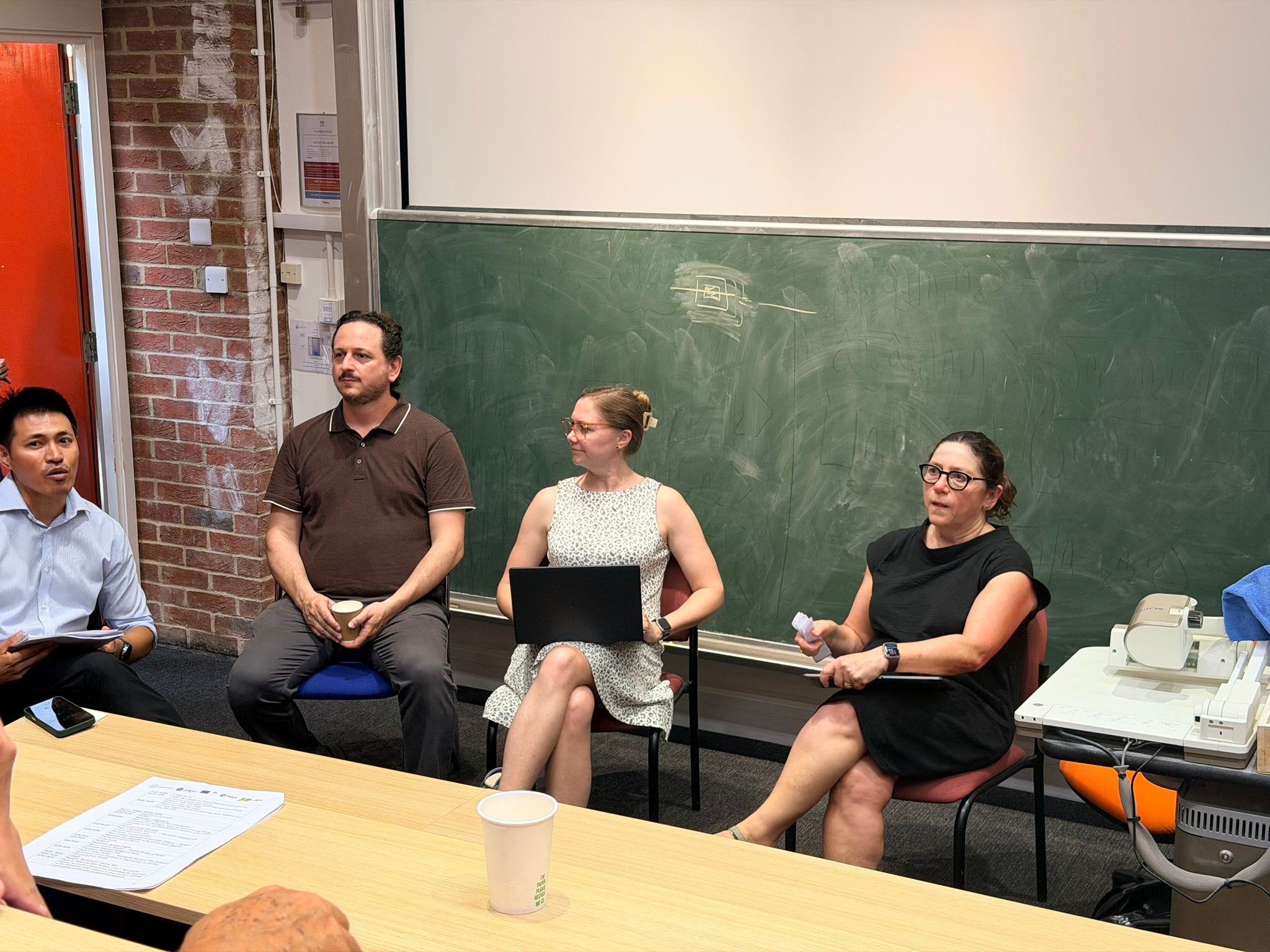
In the last week of June, amid a horrific heatwave with no air conditioning, we spent two days in a room at Sussex working through the political economy of critical raw materials. Ten papers plus an early career panel: Zimbabwe’s lithium export bans, Zambia’s three-million-tonne copper ambition, Indonesia’s nickel oligarchs, Chile’s industrial strategy and new participation experiments, Brazil’s sectoral strategies, Kazakhstan’s balancing act, and Guinea’s bauxite over the longue durée, to name a few. We launched the Handbook of Resource Nationalism in the afternoon and closed the first day with a public roundtable on minerals governance co-hosted with the Stimson Center. More than once, a speaker paused mid-sentence to check whether the recording was still running. That detail tells you something about the field right now. The people who study critical minerals, and the people who govern them, are all recalibrating what can be said out loud.
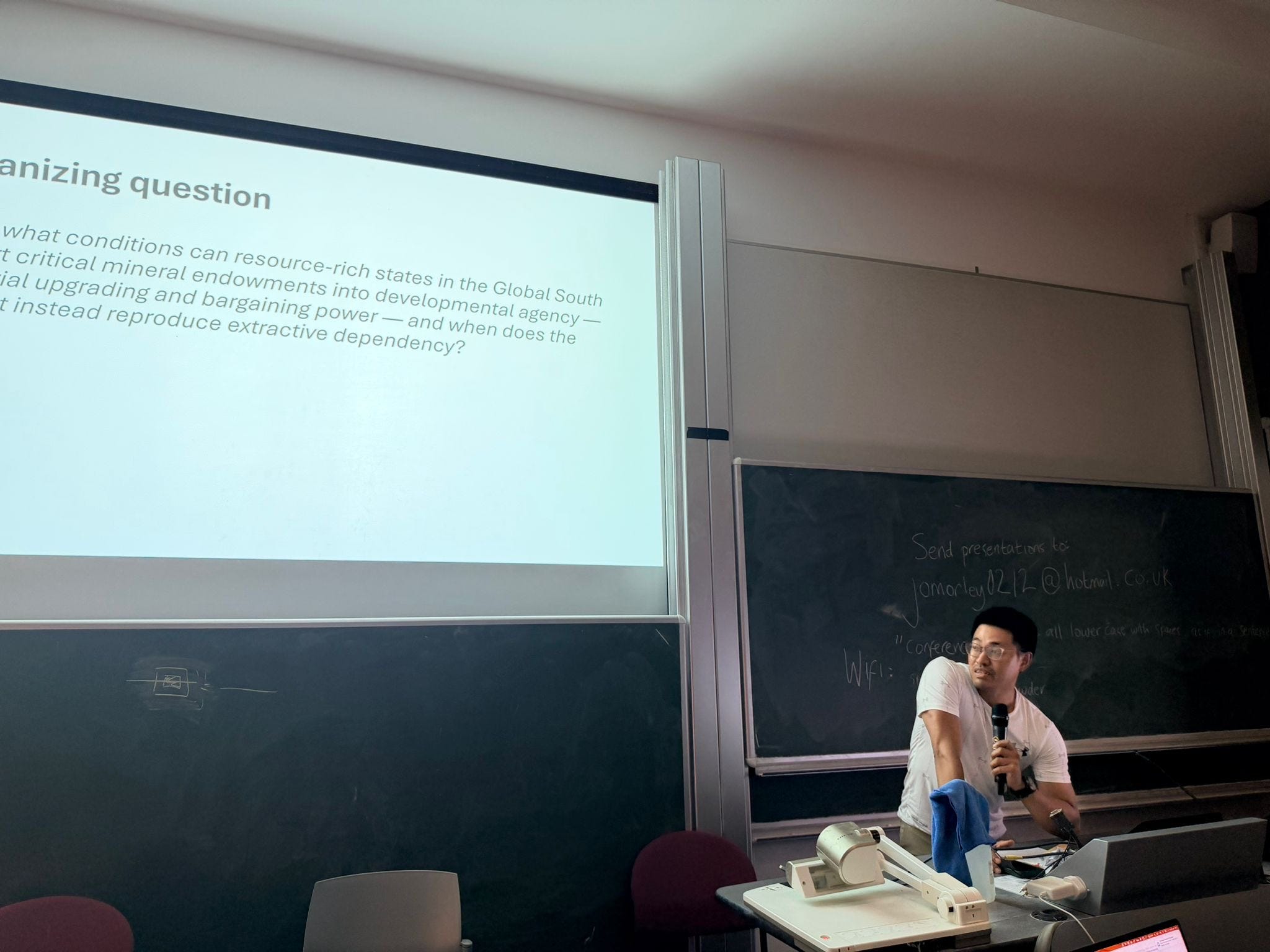
This workshop was five years in the making — the capstone of our ERC project — and I want to record what it actually taught me, rather than what the programme promised. Because, as I realized, the interesting findings were not on the programme.
The ambition is not the delivery
Nearly every mineral-producing country now has a critical minerals strategy. I propose to call this “resource developmental statecraft” (wait for my upcoming paper!). Yet almost none of them has the thing the strategy describes. This pattern became apparent, albeit unplanned, across the papers and the conversations between coffee breaks. Anabel Marin, my colleague at IDS Sussex, asked: does owning the resource endowment really mean something, if and when the knowledge to extract is held by a Chinese firm, or if the relevant patents are controlled by multinational capital?
Zimbabwe banned raw lithium ore exports in late 2022, announced a concentrates ban to take effect in January 2027, then in February 2026 abruptly suspended all raw mineral exports with immediate effect — a decision the government tied to investigations that had turned up stockpiled ore at the port of Beira in Mozambique, evidence, in its telling, of firms racing to ship material out before the 2027 deadline closed. The processing capacity these bans are meant to conjure remains mostly prospective.
Zambia, with a century-old history of copper mining and still one of the world’s largest exporters of the unprocessed metal, has joined the chorus of producers demanding more from their minerals. Its National Three Million Tonnes Copper Production Strategy aims to take output from roughly 800,000 tonnes (2024) to three million tonnes by 2031, alongside a new Minerals Regulation Act and a forthcoming local content measure — all legislated within a few years. The framing task force officials have used is blunt: this is a chance of a lifetime for Zambians, and if they miss the boat again after this boom, critical minerals might be gone for good.
This is a chance of a lifetime for Zambians — and if they miss the boat once again, after this boom, critical minerals might be gone for good.
— framing used by Zambian task force officials
The desire for industrialization built on minerals is not confined to low-income producers. Brazil has the reserves, the capacity to generate new patents and build domestic technologies, and a dense configuration of public institutions and private capital. All these favourable conditions are present, and yet a minerals-to-batteries strategy remains fragmented across sectors, incomplete, and still elusive in practice. Even Indonesia, the case every ministry I visit cites as the second-best story after China, leaves open the question of who actually captures the value. The gap between announcement and implementation was the empirical centre of gravity of our conversation.
But here the room divided in a productive way. One line of argument, pressed hard in the Zambia discussion, was that we should be careful before treating ambition as pathology. In the late 1960s, when Park Chung-hee decided South Korea needed a domestic steel industry, the World Bank refused to fund it, judging the plan economically irrational for a country at Korea’s level of development — going straight to the most capital-intensive heavy industry defied the orthodoxy of the time. POSCO’s first blast furnace came online in 1973, two years ahead of schedule, and within a decade the company was among the most efficient steel producers in the world. The lesson the room drew was not that all unrealistic targets vindicate themselves, but that “unrealistic” is not, on its own, a verdict.
The counter-argument was sharper: is the “green window of opportunity” actually causing this urgency, or is urgency a narrative constructed by those — foreign firms, domestic elites — who benefit from moving fast? One paper called the Zambian pattern “fast to develop, slow to implement.” Speed rewards what can be done quickly (publishing strategies, courting investment, expanding extraction) over what can only be done slowly (processing, skills, enforcement).
Beyond political time, an extractives-focused coalition of elites is not the same as a progressive coalition pushing for heavily regulated extraction. Nor is a processing-based coalition of business interests the same as — if not the opposite of — one content to dig ore and sell it on to firms that will ship it back to China for processing, a pattern the Belt and Road Initiative’s infrastructure loans have helped entrench across several minerals-to-manufacturing supply chains.
And beneath both positions sat the least glamorous subject at the workshop, which I have come to think is the most important one: taxation.
You learn the most about a country by its taxation structure — whether it can actually tax, who it’s extracting revenue from, and how it’s spending that revenue. It tells you everything about how society is organised, and what society can expect from the state.
As Erika Weinthal, one of the field’s leading scholars of the resource curse, put it: you learn the most about a country from its taxation structure — whether it can actually tax, who it’s extracting revenue from, and how it’s spending that revenue. It tells you everything about how society is organised, and what society can expect from the state. A country that cannot tax foreign mining companies does not have an implementation gap that time will close. It may have a permanent one.
Statecraft for whom?
The second thing the papers agreed on is that “the state” is doing a lot of work in our vocabulary that actual states cannot bear. Two papers on Indonesia traced how the coal oligarchy has migrated, largely intact, into nickel — the same networks, sometimes literally the same high-school classmates, now running the flagship case of green industrialisation. That is not simply a failure of industrial policy; a coherent conglomerate benefiting from state protection can also be a real mechanism of value-chain upgrading. To translate across disciplines: what political scientists call oligarchy — narrow decision-making, if not outright capture of the state — political economists often describe as economic groups that have historically moved from sector to sector in service of national capital accumulation. As I’ve argued elsewhere, business elites can play a genuinely developmental role, since no country grows without a private sector capable of building an industrial ecosystem at scale.
Both things can be true at once, and that is the uncomfortable part. Oligarchy concentrates power in ways that are bad for democratic accountability, and the same concentration can supply the coherence and organisational capacity needed to move up the value chain. That forces a harder question than “is this state developmental or captured”.
Is “success” measured in smelters success measured in anything else?
Perhaps what we should be asking is whether “success” measured in smelters is success measured in anything else. Should reform be aimed at strengthening small and medium enterprises and junior miners, rather than reinforcing the market power of domestic conglomerates? What does either path do to inequality and redistributive politics? Our African politics colleagues have a term for the darker variant: partisan extractivism, where state intervention channels benefits to political elites and their investment partners under the banner of industrialisation — what Peter Evans called the predatory state, and what gets called crony capitalism in the East Asian literature.
Chile posed the same question from the opposite direction. A paper on resource citizenship examined the consultation processes behind Chile’s critical minerals policy and showed that participation structures contestation as much as it opens it, with a telling geography: communities in the mining north ask for better terms of extraction, while the centre and south ask for environmental protection. The same national strategy means something different depending on where you stand relative to the pit. The discussion kept circling back to who is absent from the table — workers and unions, but also, tellingly, mining capital itself, which shapes the terms of engagement before any consultation begins. Between the oligarchs who are always in the room and the communities who rarely are, the ambition-versus-delivery gap acquires its politics.
The ground is moving under the field
The third lesson is that the external environment has changed character faster than our analytical frameworks. The development toolkit that once accompanied Western engagement with mineral producers is being dismantled in real time. Development agencies have already scaled back in favour of transactional deal-making, while accountability offices hollowed out in exchange for supply-chain access. More worryingly, the language of transparency and inclusive governance has begun to fade in favour of concrete political support — infrastructure, health assistance — offered in its place. “Choose us or China” is now closer to stated policy in Washington, and increasingly the operating assumption in Brussels and Tokyo too. But that framing assumes producer countries are the ones doing the choosing, when the more accurate description may be that the binary is being imposed on them rather than offered to them.
The workshop complicated the picture from below as well. In Zambia, the recent surprises have come less from Washington or Beijing than from Abu Dhabi and Riyadh. Abu Dhabi’s International Resources Holding took a majority stake in Mopani Copper Mines in a $1.1 billion deal at the end of 2023 and has since been in talks over Konkola Copper Mines, while Saudi Arabia’s Manara Minerals has been exploring stakes of its own. Gulf capital is now enmeshed in African resource politics — financing mining, infrastructure, and increasingly green energy projects — in ways the US–China framing doesn’t capture. The field keeps writing US–China; the balance sheets increasingly say otherwise.
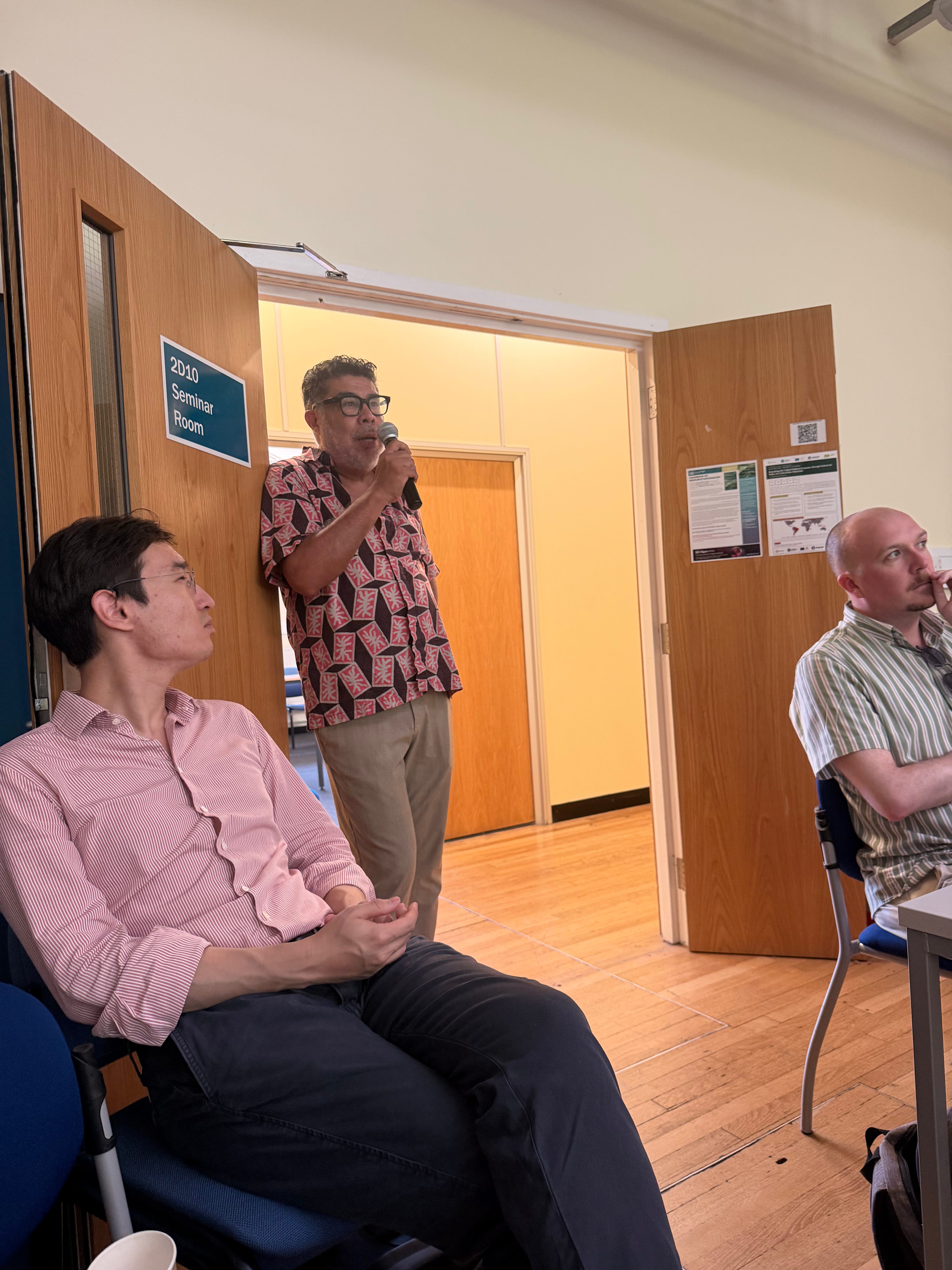
Discussion during the Critical Raw Materials Workshop, University of Sussex, 25–26 June 2026. Daniel Chavez asking questions here.
We came to this workshop with a concept — developmental resource statecraft — and a hunch that the Global South’s mineral producers are remaking the global political economy from below. We leave with something more precise and more defensible: statecraft is everywhere, delivery is rare, and the analytically interesting question is what separates the two. State capacity and coherence; the coalitions and ideas that hold a strategy together across electoral cycles; a country’s structural position in supply chains it does not control. That conditions question is what the special issue we are now assembling will try to answer.
Five years ago, I wrote this project on an optimistic premise: that industrial policy was coming back, and that mineral producers would not be spectators. Both turned out to be true. What two days at Sussex added was the discipline. The return of the state is not the same as the return of development, and our job now is to specify, case by case, or through rigorous comparison, when one becomes the other.
Jojo Nem Singh is Principal Investigator of the GRIP-ARM (Green Industrial Policy in the Age of Rare Metals) project, a European Research Council–funded project at the University of Sussex. The workshop “Remaking the Global Political Economy through Industrial Policy in Critical Raw Materials” took place at Sussex on 25–26 June 2026.